
Book quiz
Leaders Eat Last: Why Some Teams Pull Together and Others Don't Quiz
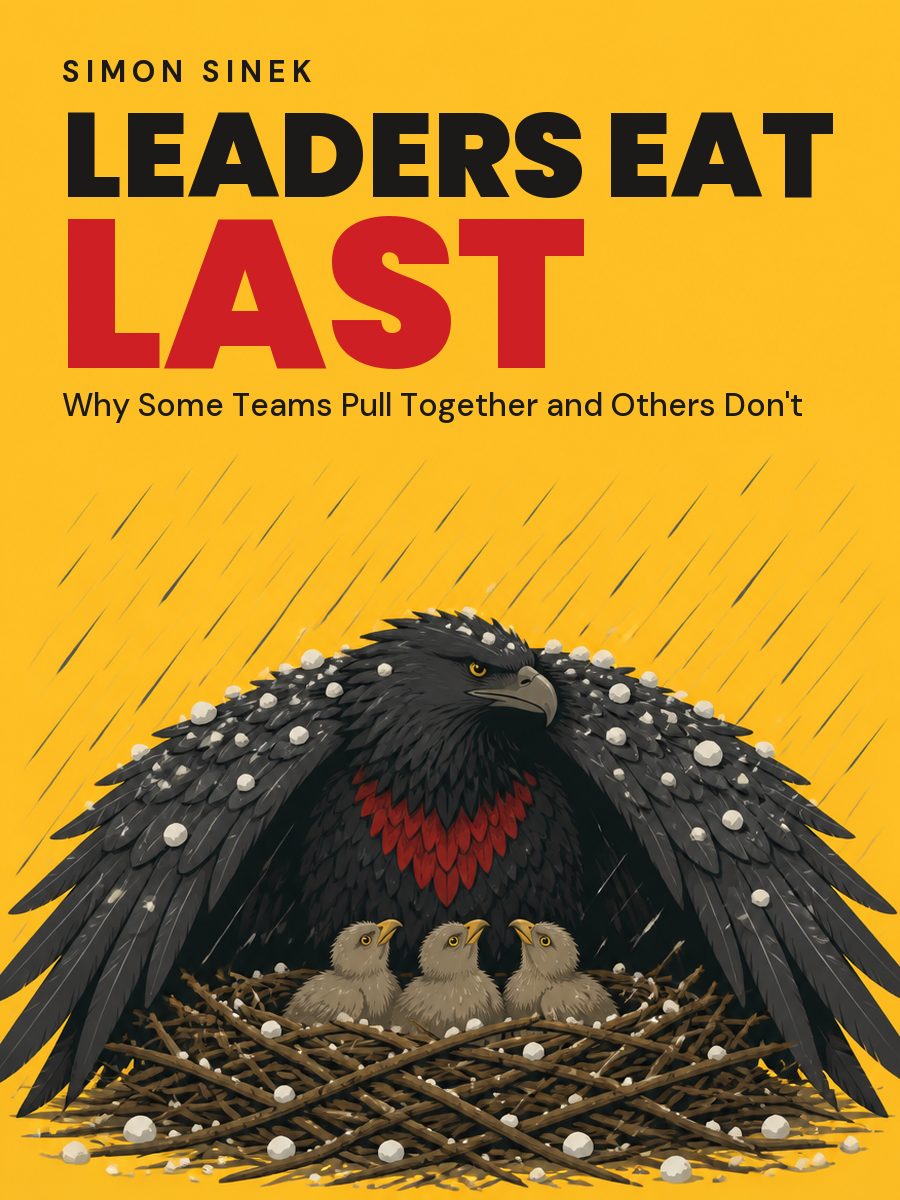 Leaders Eat Last: Why Some Teams Pull Together and Others Don'tSimon Sinek
In some teams people risk themselves for one another. In others they hide their mistakes and wait for a knife in the back. Simon Sinek looked for the reason among Marines, military pilots and factory owners. The answer was not pay or talent. It was whether people feel safe among their own. The book shows how a leader…
Question 1 of 5
A new employee spots a wrong figure in a client report. Per Sinek, what decides whether he speaks up at once?
Show the answer
Right answer: Whether the team mocks whoever is at fault
Where people must protect themselves from their own, mistakes get hidden and bad news arrives late. Inside a strong circle of safety, problems are raised early.
Question 2 of 5
A department missed its deadlines, and the director asks who is to blame. What does a real leader do, per Sinek?
Show the answer
Right answer: Takes the blame: "hold me responsible"
People accept a leader's privileges in exchange for protection. When danger comes, the leader steps toward it first, and later the team covers for that leader in turn.
Question 3 of 5
Two nurses work equally long shifts. According to the book, why is one more drained by the end?
Show the answer
Right answer: She clears every step and expects a reprimand
In the author's model, stress comes not from the number of tasks but from feeling that nothing depends on you. So powerlessness wears people out, not the load.
Question 4 of 5
According to Sinek, why is it so easy for the head of a large company to cut staff?
Show the answer
Right answer: They see rows in a spreadsheet, not people
This is abstraction, as in Milgram's experiments: the more distant a person is and the more like a number, the easier it is to harm them. Hence Sinek's advice to keep groups small.
Question 5 of 5
A small restaurant loses revenue in winter. Which decision is closest to what Chapman did?
Show the answer
Right answer: Everyone works fewer shifts, the owner first
Chapman reasoned that it is better for everyone to suffer a little than for a few to suffer a lot. When losses are shared by all, people start protecting each other.
Want all of the book's key ideas? Read or listen to its retelling in Livria.